
LiDia-SEQ™ – Genomic Analysis on a Microchip
BRINGING CUTTING-EDGE TECHNOLOGY TO THE PATIENT
Clinicians have had to accept the trade-off between speed and relative ease of use of conventional assays against the information richness, complexity and unwieldiness of next-generation sequencing (NGS).
DNAe bridges this gap with LiDia-SEQ, its semiconductor sequencing-based diagnostic system, where analysis and read-out take place on a single silicon chip, and run direct from sample in a rapid, easy-to-use format. The system can perform a range of genomic analyses, to deliver fast, accurate and insightful diagnoses.
This is truly a breakthrough device which offers an entirely automated end-to-end solution that rapidly delivers clinically actionable results, without high start-up and running costs or the need for specialized users and labs.
A complete end-to-end diagnostic solution for a fast actionable result
LiDia-SEQ™ WORKFLOW
Analyze and report within a work shift
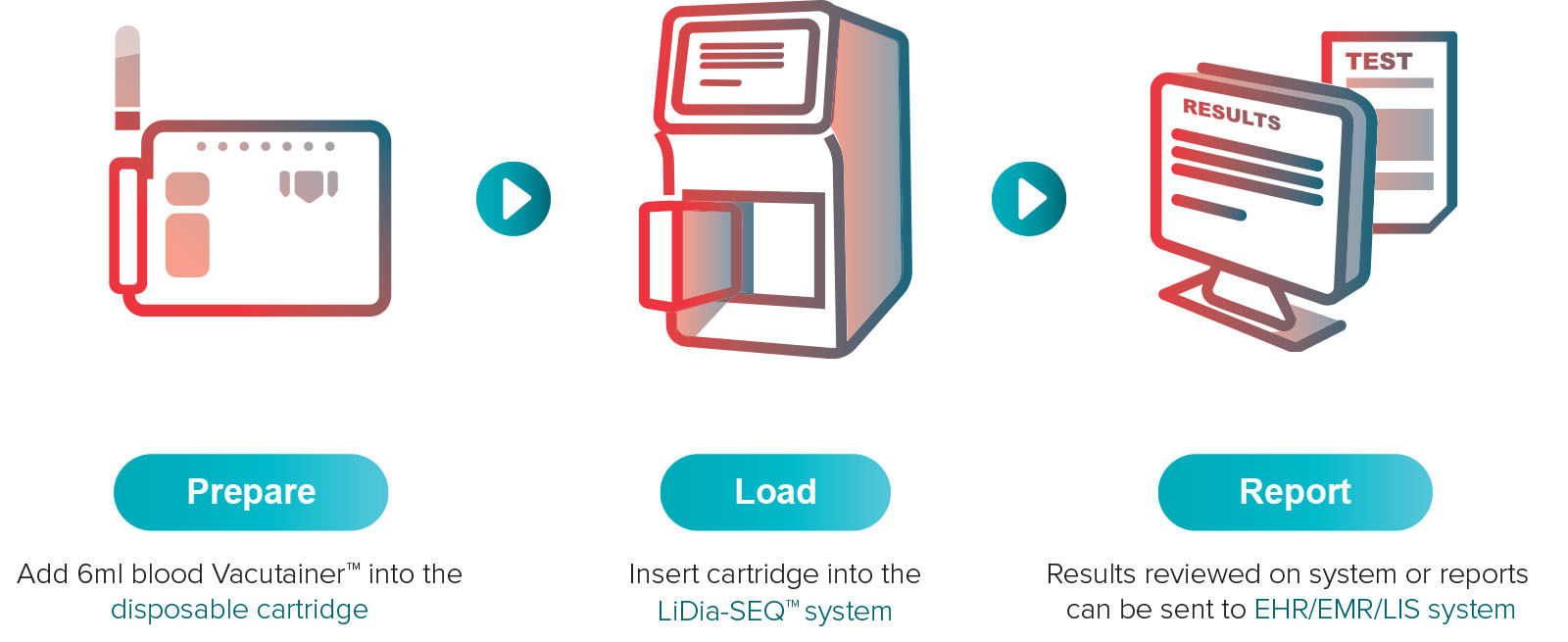
The sample is processed using a proprietary mixture of immunomagnetic beads that specifically and rapidly extract bacterial and fungal pathogens at very low clinically relevant concentrations.

This ability to capture and concentrate low concentration pathogens in a complex matrix eliminates the need for blood culture, which significantly reduces the time to diagnosis. The system is being developed alongside our first test, a groundbreaking test which detects and identifies pathogens that lead to sepsis from whole blood samples. By providing rapid actionable information to clinicians at the point-of-need, we can enable them to administer appropriate treatment, helping to save patients’ lives.
DETECTION BY SEMICONDUCTOR-BASED GENOMIC SEQUENCING
Our novel semiconductor sequencing technology uses a silicon transistor, the established building block of modern microelectronics, to detect nucleotides as a simple electrical signal.
As nucleotides are incorporated during the step-by-step construction of nucleic acids, they release hydrogen ions which can be detected as an electrical signal. If there is no match, no hydrogen ions are released, and no signal is detected.
This method is universally applicable to sequencing of any DNA or RNA on a standard CMOS semiconductor chip. There is no need for fluorescent dyes or labels, or precision optics, which make current DNA analysis equipment bulky and expensive.
No need for fluorescent dyes or labels, or precision optics
INTELLECTUAL PROPERTY
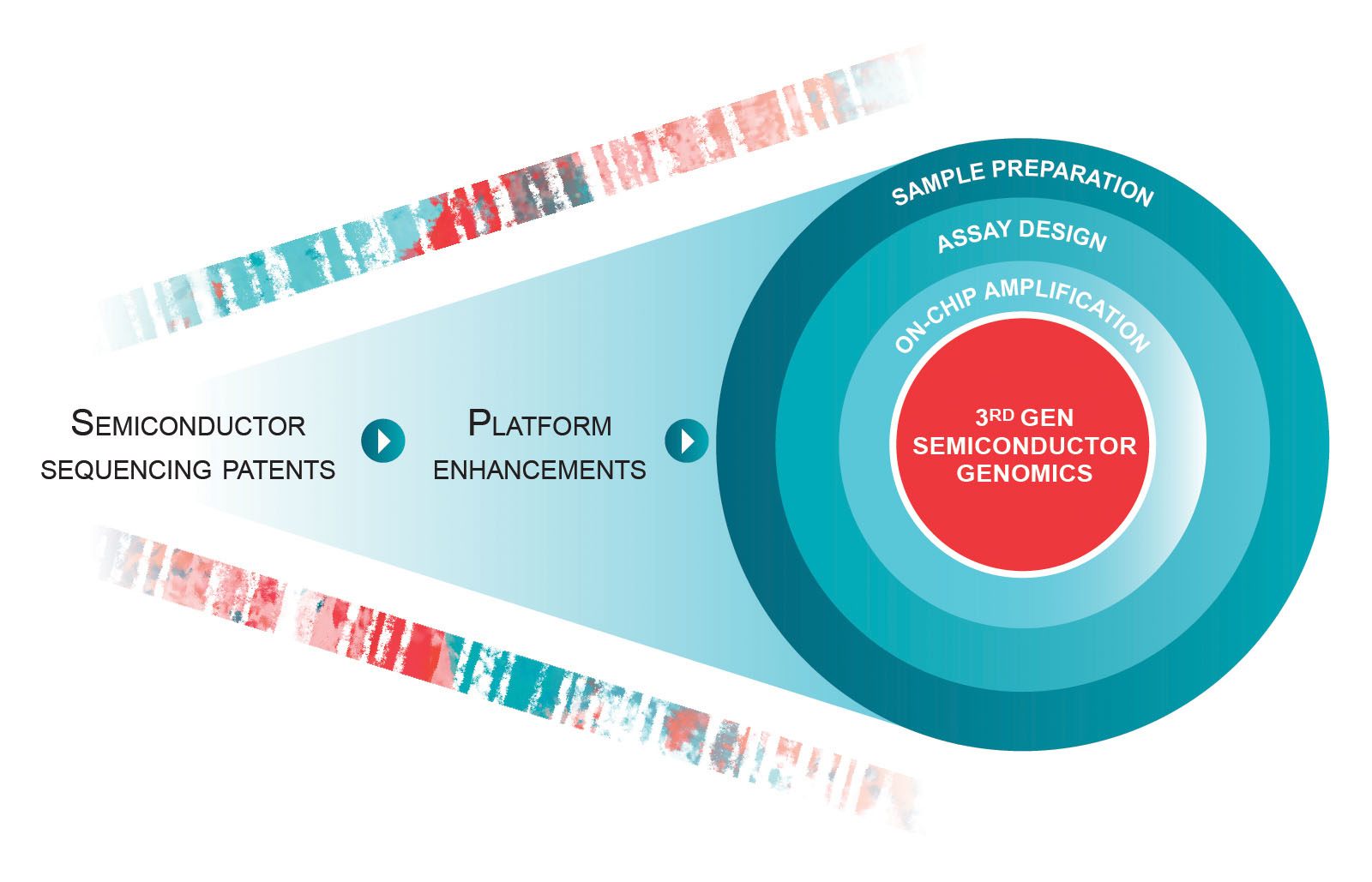
DNAe has developed a wide portfolio of patents and know-how around semiconductor technology, systems engineering and molecular biology for life science applications.
Since we invented semiconductor DNA sequencing using ion detection, we have created many innovative and practical solutions to speed up, simplify and enrich diagnostics at the point-of-need.
Our core patents cover a number of innovations.
Licensees
DNAe has granted limited, non-exclusive licenses to certain patents to a small number of life science companies, including Ion Torrent (now part of Thermo Fisher Scientific). As a result, our technology is now validated for next-generation sequencing applications in laboratories around the world. DNAe retains certain exclusive rights to its technologies.